

About the Book
In the creation of this photo book my aim was not to rewrite the story but to distill it, to reimagine the text in poetry and yet use its own language to do so—to find the secret meanings within. My methods differed, ranging from the very readable to the cryptic, sometimes adding significantly to the text, sometimes minimally. Let me try to explore this project, in terms of images and text:
PHOTOGRAPH CATEGORIES
Each act represents a different style or subject of photography: European travels, abstracted portraits, suburban dystopia, natural landscapes, and—to conclude the series—photographs of old photographs.
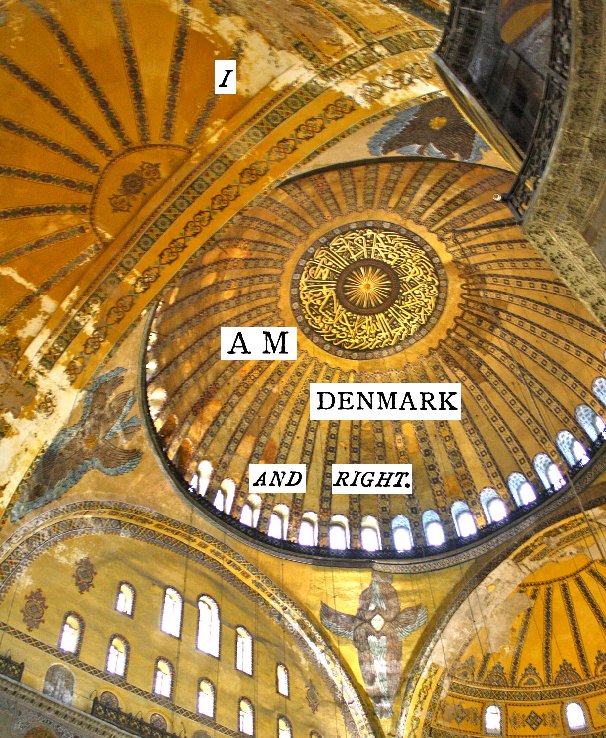
The first section, comprised of photos I took in Frankfurt, Rome, Amsterdam, and Istanbul, introduces the reader to the grandeur and dignity implied by a European castle. It serves as the presentation of place, while the second section, a series of cropped and abstracted portraits, serves as the presentation of personality. Certain individuals appear more frequently than others in order to represent the distinction between primary and secondary characters, but no individual is “cast” in a specific role. What’s more, the photographs are abstracted in order to question the universality of the story—can we replace Hamlet with Tyler or Alisa or Jesse? Is this tale mythological in its scope or is it small and specific? In my cropping, I made sure to retain the necessary components of the portrait (which depended on the specific image) while reducing it to its primal state.
The third act then uses the introductions of the characters as a catalyst to transform European grandeur to suburban squalor. The images in this section are unkempt and unappealing, a reflection on how we see Denmark once we learn of its inhabitants. This act’s photographs rely on the widespread belief that one’s dwelling is a reflection of oneself and one’s morals, that good people have well-kept homes. (This principle is exemplified by many home makeover shows, like “Hoarders” or “Extreme Makeover: Home Edition.”)
In the fourth act, we see multiple attempts at escape: Hamlet is sent off to England while Ophelia drowns, both freed from the depravity of Denmark. This is reflected through natural imagery, a contrast to the preceding suburban photos. Several of these photographs have religious connotations as well (like the monastery built into a rock wall), while others portray ancient ruins; this serves to depict the timelessness of abstract ideals and the mortality of concrete structures. Our bodies will die—but our words, our poems, our plays, will live on.
Such hopefulness, however, is slightly undermined by the final act. Act five is comprised of photographs of an old album, which symbolize the ephemerality of person and personality—and of the photo book itself. They situate the book as a self-conscious artifact. Everyone in these images is dead or dying, and so the photographs act as skulls.
INTERACTION BETWEEN PHOTOGRAPHS
Each act uses a different form of image interaction, selected based on the momentum desired or required. The very dramatic second and fourth acts interact according to facing images so as to slow down the reader, while the less dramatic acts one and three interact along page turns to propel the reader forward. To illustrate: in act two, the faces appear to be looking at one another, while in act three, two images of bicycles are separated by a page turn.
Act five, however, is different: facing pages are two halves of a split image that serve to stop the reader for long periods of time—not because this section is dramatic but because it should be meditative. It also subtly represents the dislocation of death felt by those who witness it.
INTERACTION BETWEEN PHOTOGRAPH AND TEXT
In all cases, the photograph is meant to interact in some way with the text, either through literal or metaphorical mechanisms. These connections are fairly easy to detect and are better left to the reader to deduce.
What is of more interest, I believe, is the physical interaction of words and images: where the words are situated in relation to the photograph. At certain points this physical interaction is definite, and at others only tangential. When I began creating the photo book, only three situations seemed possible: (1) the text was cut primarily according to meaning, and so physical interaction was minimal; (2) the text was cut primarily to match its accompanying photograph, and so physical interaction was great; or (3) the text was cut according to meaning but by coincidence it also interacted strongly with the image.
The first situation is exemplified by a photograph in act one, the image of the two circular maps. My goal of highlighting the roles of duty and fate did not line up with the double circles in the image, and so the words complement the image in meaning and metaphor but not in physicality. The second situation, in which the text is cut to match the photo, is quite apparent in an image of baskets in act three. Each basket contains three to four words that fit in a certain category: the concrete, the kingly, and the ethereal.
An example of the third situation can be found in act one, in the photograph of a twilight path with overarching trees. The text was cut to select for the cock’s crowing and the watchers’ parallel exclamations, but by chance these words also traced the path of the tree’s arch. Throughout the process of book creation, this result was actually more common than one might expect.
When I got more comfortable with the process, however, I was able to simultaneously consider both image and text (helped by a bit of chance and good luck). These, I believe, are the strongest images in the book, and many of them come in act five. My favorite has the words “prithee, take thy fingers from my throat” pinched between two fingers: the hand is actively reaching into the album, thereby “leap[ing] into the grave.”
This is the perfect exemplar of what the book was meant to be: a commingling of text and image, wherein the sum of the components was something greater than its individual parts.
PHOTOGRAPH CATEGORIES
Each act represents a different style or subject of photography: European travels, abstracted portraits, suburban dystopia, natural landscapes, and—to conclude the series—photographs of old photographs.
The first section, comprised of photos I took in Frankfurt, Rome, Amsterdam, and Istanbul, introduces the reader to the grandeur and dignity implied by a European castle. It serves as the presentation of place, while the second section, a series of cropped and abstracted portraits, serves as the presentation of personality. Certain individuals appear more frequently than others in order to represent the distinction between primary and secondary characters, but no individual is “cast” in a specific role. What’s more, the photographs are abstracted in order to question the universality of the story—can we replace Hamlet with Tyler or Alisa or Jesse? Is this tale mythological in its scope or is it small and specific? In my cropping, I made sure to retain the necessary components of the portrait (which depended on the specific image) while reducing it to its primal state.
The third act then uses the introductions of the characters as a catalyst to transform European grandeur to suburban squalor. The images in this section are unkempt and unappealing, a reflection on how we see Denmark once we learn of its inhabitants. This act’s photographs rely on the widespread belief that one’s dwelling is a reflection of oneself and one’s morals, that good people have well-kept homes. (This principle is exemplified by many home makeover shows, like “Hoarders” or “Extreme Makeover: Home Edition.”)
In the fourth act, we see multiple attempts at escape: Hamlet is sent off to England while Ophelia drowns, both freed from the depravity of Denmark. This is reflected through natural imagery, a contrast to the preceding suburban photos. Several of these photographs have religious connotations as well (like the monastery built into a rock wall), while others portray ancient ruins; this serves to depict the timelessness of abstract ideals and the mortality of concrete structures. Our bodies will die—but our words, our poems, our plays, will live on.
Such hopefulness, however, is slightly undermined by the final act. Act five is comprised of photographs of an old album, which symbolize the ephemerality of person and personality—and of the photo book itself. They situate the book as a self-conscious artifact. Everyone in these images is dead or dying, and so the photographs act as skulls.
INTERACTION BETWEEN PHOTOGRAPHS
Each act uses a different form of image interaction, selected based on the momentum desired or required. The very dramatic second and fourth acts interact according to facing images so as to slow down the reader, while the less dramatic acts one and three interact along page turns to propel the reader forward. To illustrate: in act two, the faces appear to be looking at one another, while in act three, two images of bicycles are separated by a page turn.
Act five, however, is different: facing pages are two halves of a split image that serve to stop the reader for long periods of time—not because this section is dramatic but because it should be meditative. It also subtly represents the dislocation of death felt by those who witness it.
INTERACTION BETWEEN PHOTOGRAPH AND TEXT
In all cases, the photograph is meant to interact in some way with the text, either through literal or metaphorical mechanisms. These connections are fairly easy to detect and are better left to the reader to deduce.
What is of more interest, I believe, is the physical interaction of words and images: where the words are situated in relation to the photograph. At certain points this physical interaction is definite, and at others only tangential. When I began creating the photo book, only three situations seemed possible: (1) the text was cut primarily according to meaning, and so physical interaction was minimal; (2) the text was cut primarily to match its accompanying photograph, and so physical interaction was great; or (3) the text was cut according to meaning but by coincidence it also interacted strongly with the image.
The first situation is exemplified by a photograph in act one, the image of the two circular maps. My goal of highlighting the roles of duty and fate did not line up with the double circles in the image, and so the words complement the image in meaning and metaphor but not in physicality. The second situation, in which the text is cut to match the photo, is quite apparent in an image of baskets in act three. Each basket contains three to four words that fit in a certain category: the concrete, the kingly, and the ethereal.
An example of the third situation can be found in act one, in the photograph of a twilight path with overarching trees. The text was cut to select for the cock’s crowing and the watchers’ parallel exclamations, but by chance these words also traced the path of the tree’s arch. Throughout the process of book creation, this result was actually more common than one might expect.
When I got more comfortable with the process, however, I was able to simultaneously consider both image and text (helped by a bit of chance and good luck). These, I believe, are the strongest images in the book, and many of them come in act five. My favorite has the words “prithee, take thy fingers from my throat” pinched between two fingers: the hand is actively reaching into the album, thereby “leap[ing] into the grave.”
This is the perfect exemplar of what the book was meant to be: a commingling of text and image, wherein the sum of the components was something greater than its individual parts.
Features & Details
- Primary Category: Fine Art Photography
-
Project Option: Standard Portrait, 7.75×9.75 in, 20×25 cm
# of Pages: 120 - Publish Date: Apr 26, 2011
See More